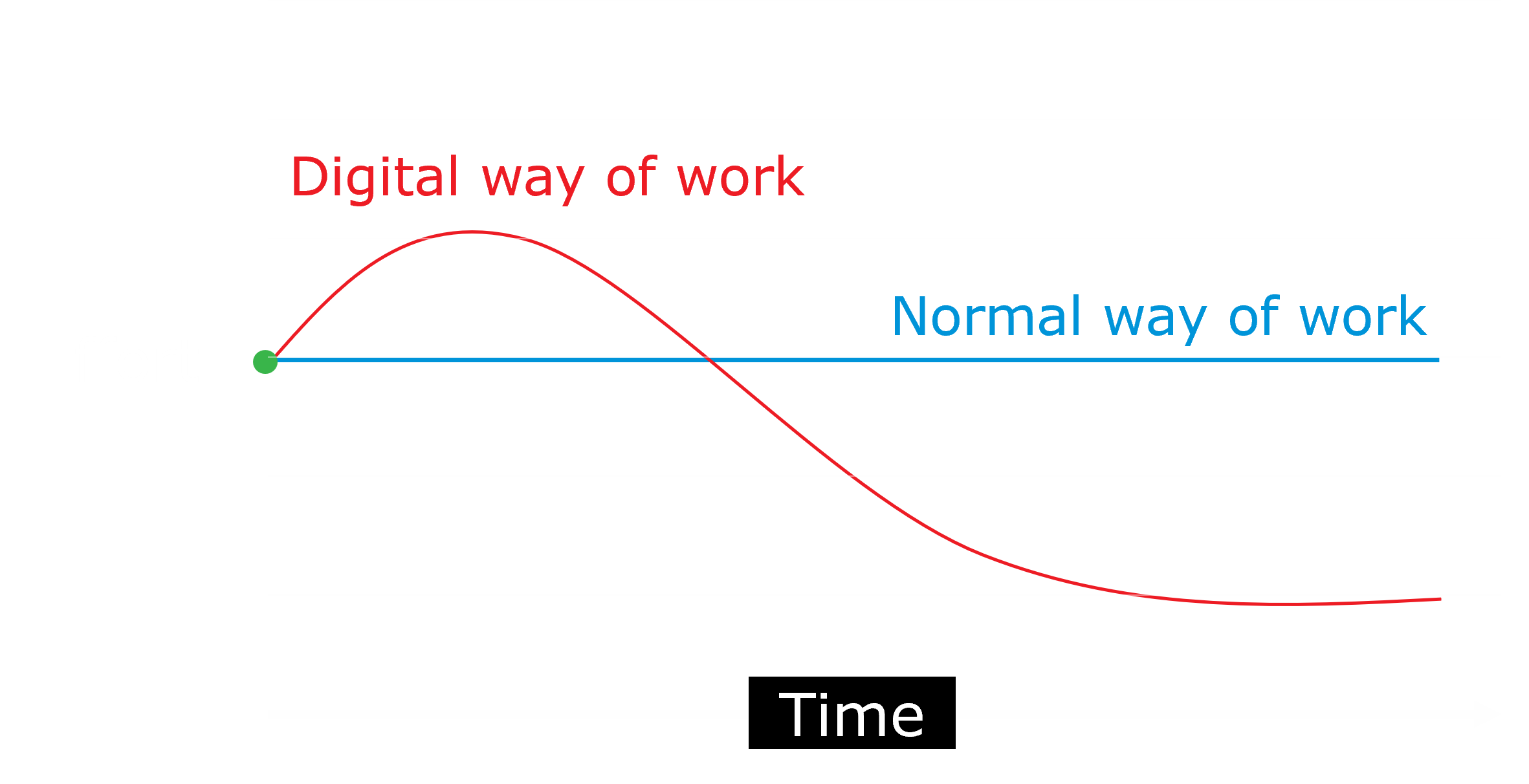
While the trajectory of effort is same for all changes, not all change is created equal though. Based on the author’s experience leading digital change tends to follow one of three distinct patterns over time. Recognizing which one you are dealing with should influence how the change should be planned and communicated. let us look at each of these patterns in detail with examples.
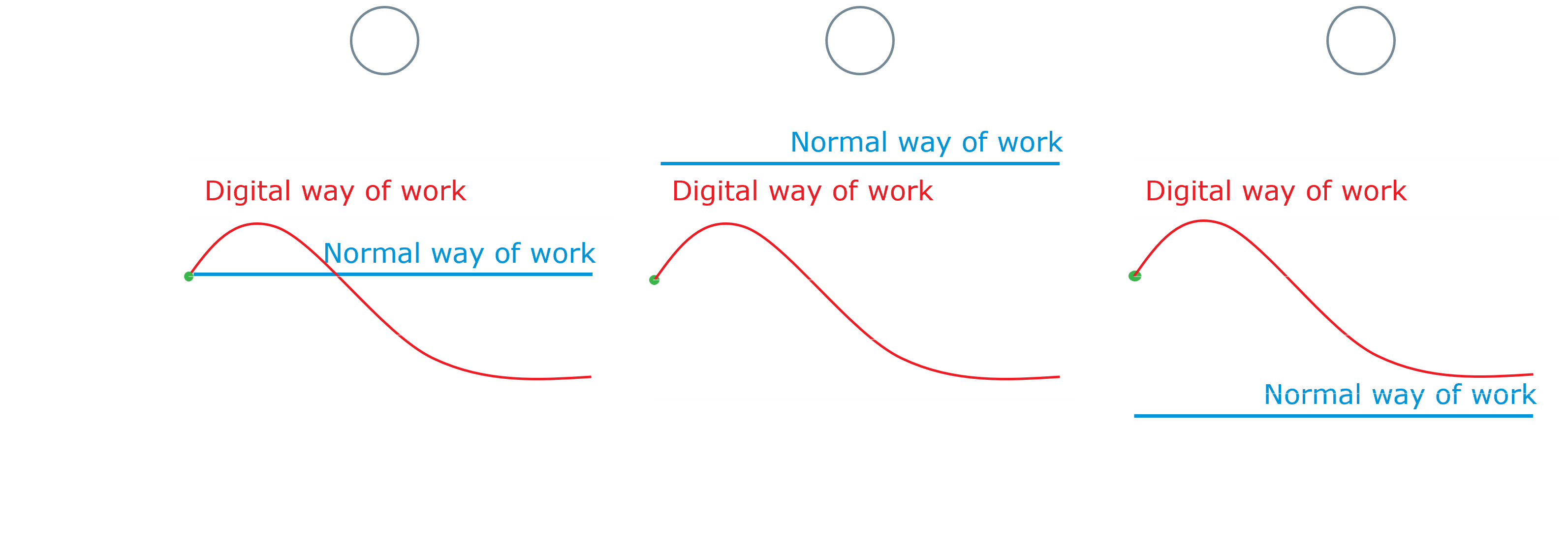
Pattern one: steady state effort ends up below normal
Take automation as an example. Rolling out an automated workflow — an approval process, a reporting pipeline, a data extraction step—takes real effort to learn and use. During that period, people are doing their normal work and learning the new system at the same time, so effort climbs above the old baseline. Once it is built and adopted, though, the ongoing effort needed hopefully drops below what the old, manual way required. The whole point of the investment was to end up lower than where you started.
This is probably the default expectation when people think about digital change. That there is a short term pain for the longer term gain. And just like any change effort, people need to be supported through the painful middle.
Pattern two: change effort stays below normal at all times
In this scenario, the current effort needed is so high that the digital way of working, even in its most difficult period, takes less effort than the old way. You need very little convincing to get people to take to the digital way of working. This does not happen often but you will encounter such scenarios ocassionally. Take automation of KPI calculations as an example. If the KPI does not pop out straight from a database, there is probably a bunch of people who are calculating it manually using spreadsheets. This is doable up to a point when KPI calculation is needed a few times, say once or twice in an year. Now if the KPI needs to be calculated say daily, such way of working is simply not realistic. Automation of pipeline that pulls in data from multiple sources and calculates the KPI becomes the most feasible way to do this.
You are lucky if you are in this scenario. The change will be embraced much more readily by users because it really makes the impossible possible for them.
Pattern three: steady state effort stays above normal, permanently
In this scenario, a new way of working permanenty needs a higher effort than the old way. How does this hapen? After all organizations introduce digital initiatives with an aim to make things easier and faster. This usually happens, because without realizing (and certainly communicating) organizations are aiming for two benefits, one is to improve the quality, and second is to do so with less effort. Here is an example. Let us say you managed data of your products in Excel spreadsheets, and now your organization decides to implement a commercial PLM or PIM system. Before PLM, since the data was managed in Excel, you likely had limited restrictions on the quality of data entered in Excel, and had no approval flows either, so things were faster but that resulted in lots of errors and rework downstream. A PLM system on the other hand, will natively enforce quality checks and approval. As a consequence, now more data is entered into the system, and the quality is rigorous. But this comes at a cost of more effort despite introducing a new system.
This is one of the most unrecognized pattern in digital. Espeically senior management is unaware of the nuts and bolts of this kind of change, and assume that a new tool that costs a lot, automatically has be better and most importantly faster. But they fail to recognize that with the tool, they have now placed a higher bar on the data quality and to meet this bar is going to take more effort, no matter what. Change management is absolutely critical for such changes to succeed, and the change management needs to involve all layers of the organization. Most digitalization initiatives fail because tools get oversold on the benefits, without truly understanding the additional effort that are needed even in the new steady state.
Recognize your situation before you plan the change
The practical question to ask before any digital change is not just “how hard will the rollout be.” It is “where does effort actually settle once the dust clears—below normal, back to normal, or permanently above it.” That single question changes three things: what you promise people, what kind of support you resource for afterward, and how you judge whether the initiative worked.
A change expected to land below normal needs strong, repeated communication about the future payoff to get people through the hard middle. A change expected to land back at normal needs to be sold honestly on quality, not effort, or it will feel like a broken promise. A change expected to stay above normal needs permanent, not temporary, support, since the new way of working was never going to get easier than the old one, only more valuable.
Two levers that help drive the change regardless of the pattern
Whichever pattern applies, two things stay within your control, at the peak and after it.
Try to lower or narrow the peak. The peak climbs highest and lasts longest when people are left to learn a new way of working on their own, squeezed in around a job that has not gotten any lighter. Hand-holding, dedicated time set aside to learn rather, and on-the-job support available at the exact moment someone gets stuck, all bring the peak down and shorten how long it lasts. Lowering the transition costs for the people going through will help them get over it easier and faster.
Ensure steady state effort is low. If the organization strives to ensure that steady state of working remains below the normal way, then people are more likely to embrace change with enthusiasm. This needs to be taken into account during the design stage itself. If the digital team is cognizant of user expectations, and can build in features that meet those expectations, the reward will be higher adoption. In fact it also helps in the third scenario. Even if the steady state effort is higher than normal, it still pays to have a lower steady state level for better adoption.
Frequently asked questions
Does digital change always get easier once the transition period is over?
No. Some initiatives do settle into a lower effort baseline than before, but others return to the same level of effort, and some permanently require more effort than the old way did. Knowing which pattern applies matters more than assuming the first one by default.
Why does effort sometimes stay above normal permanently after a digital change?
Because the new way of working requires ongoing discipline the old way did not—entering every product change into a PLM system properly, for example, instead of a quick email or a side spreadsheet. The payoff is not less effort; it is traceability and visibility that the old, looser way never gave anyone.
How should a KPI dashboard rollout be communicated if effort will not actually decrease?
Honestly, and around the real benefit: better and faster access to information, not time saved. Promising an effort reduction that never arrives damages trust in the initiative and in future ones.
What is the practical use of recognizing these three patterns in advance?
It changes what you promise people, what kind of support gets budgeted after launch, and how success gets measured. Planning as if every change eventually gets easier, when some permanently will not, sets a change up to feel like a failure even when it worked exactly as intended.
What can be done to make a digital change stick, no matter which pattern applies?
Two things. Before the peak, lower and shorten it with hand-holding, dedicated learning time, and support available the moment someone gets stuck. After the peak, make sure the new way is an obviously better choice than reverting to the old one, or people will quietly drift back once nobody is watching.